
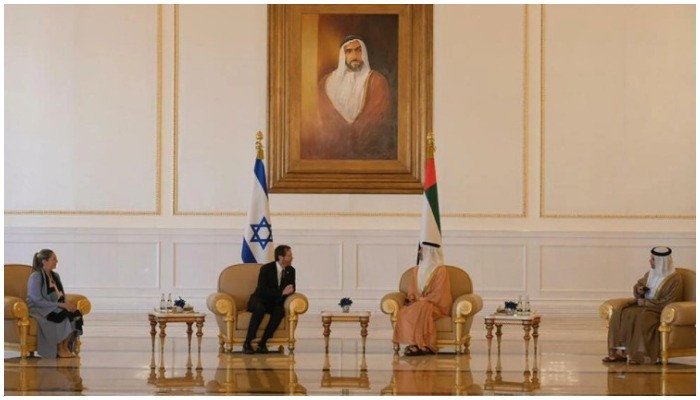


- Herzog, traveling with the first lady, arrives in the capital of the UAE around 0800 GMT.
- Meet Foreign Minister Sheikh Abdullah bin Zayed Al-Nahyan.
- Herzog also meets Abu Dhabi Crown Prince Sheikh Mohammed bin Zayed Al-Nahyan at the presidential palace.
Israeli President Isaac Herzog began his first visit to the United Arab Emirates on Sunday, the last high-profile diplomatic trip since the countries normalized ties.
It follows a visit by Naftali Bennett last month, the first by an Israeli prime minister, at which both sides discussed Iran’s nuclear program, a major Israeli security issue.
Herzog, who was traveling with the first lady, arrived in the UAE capital around 0800 GMT where he met Foreign Minister Sheikh Abdullah bin Zayed Al-Nahyan, the president’s office said.
“Start with an Israeli president’s first visit to the United Arab Emirates,” Herzog tweeted upon arrival. “We were delighted and deeply moved by the warm welcome to Abu Dhabi.”
The visit comes some 16 months after the wealthy Gulf country forged diplomatic ties with Israel, becoming the third Arab nation after Egypt and Jordan.
Herzog also met Abu Dhabi Crown Prince Sheikh Mohammed bin Zayed Al-Nahyan at the presidential palace, official Emirati news agency WAM said.
“The national anthems of the two countries were played, while 21 artillery shots were fired to welcome his visit,” the report said.
Sheikh Mohammed expressed hope that the visit would improve bilateral relations, WAM said, adding that the pair discussed cooperation in areas such as economy, trade, investment, development, technology and health.
The president’s office said the meeting lasted more than two hours.
Geopolitical interests
“We fully support your security demands and we condemn in any form and language any attack on your sovereignty by terrorist groups,” Herzog’s office quoted him as saying during the meeting.
Abu Dhabi was hit this month by a missile and drone strike that killed three foreign workers – the first deadly attack on UAE soil, claimed by Huthi rebels in Yemen and recognized by the Emirates.
“We are here together to find ways and means to bring complete security to people seeking peace in our region,” he added.
Herzog, whose function is largely ceremonial, would also meet Prime Minister and ruler of Dubai, Sheikh Mohammed bin Rashid Al-Maktoum, on the two-day trip – the first official visit to the UAE by an Israeli head of state.
A 2020 normalization agreement between the two countries was one of a series of US-brokered agreements known as the Abraham Accords.
The deals angered Palestinians and broke decades of Arab League consensus against recognizing Israel until it signs a peace accord establishing a Palestinian state with a capital in East Jerusalem.
The accords were negotiated by Bennett’s predecessor, Benjamin Netanyahu, who said they would offer Israel new regional allies against Iran and strengthen its diplomatic efforts to stop Tehran from acquiring nuclear weapons.
Iran has long been Israel’s nemesis, and the Jewish state is deeply skeptical of continued efforts by world powers to revive a 2015 agreement that lifted Tehran’s sanctions in exchange for restrictions on its nuclear program. .
The UAE has strained relations with Iran and supports government-affiliated forces fighting Tehran-backed Huthi rebels in Yemen’s civil war.
Transform the Middle East
Herzog, who would also visit Expo 2020 Dubai and meet with members of the Jewish community, vowed this month that “the bold new partnership” between Israel and the UAE will “transform the Middle East”.
About 200,000 Israelis visited the UAE in the first 12 months after the standardization agreement was signed, and about 40 Israeli companies have settled there, according to the Israeli consulate in Dubai.
Since normalization, the countries have signed economic and trade cooperation agreements ranging from tourism to financial services.
Emirati Ambassador to Israel Mohamed Al Khaja said ahead of Herzog’s trip that it would improve bilateral relations “as we aim to sign important economic and trade agreements… in the near future”.
The Abraham Accords were negotiated under former US President Donald Trump and ratified by the administration of President Joe Biden.
Bahrain and Morocco have also normalized ties with Israel under the accords. Sudan has agreed, but formal diplomatic relations have not yet been established due to the escalating instability in Khartoum.