
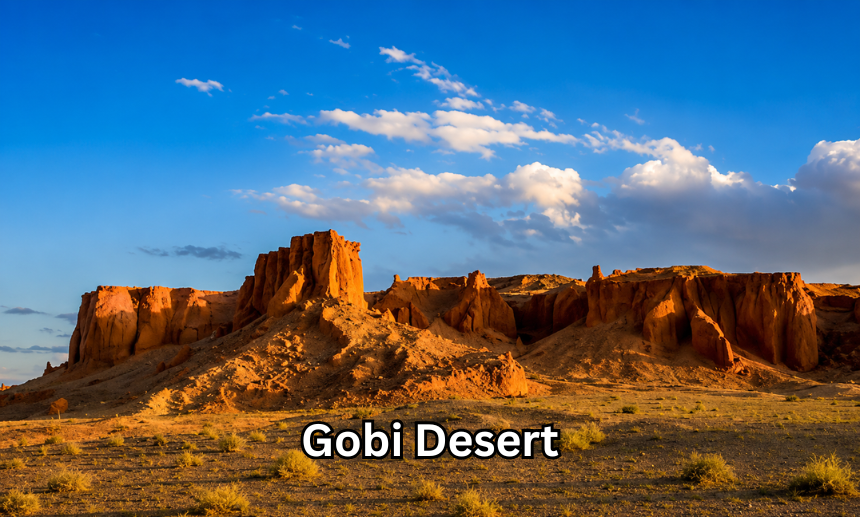

When most people hear the word “desert,” they imagine endless golden dunes, intense heat, and almost no life. The Gobi Desert challenges every part of that picture. It is a vast cold desert where winter snow can cover rocky plains, wild camels travel between scarce water sources, and dinosaur fossils remain buried beneath ancient layers of earth.
So, where is the Gobi Desert? It stretches across southern Mongolia and northern China in the heart of East Asia. However, understanding its location is only the beginning. The Gobi is not one uniform sea of sand. It contains gravel plains, mountains, dry valleys, grassland, cliffs, dunes, and protected wildlife habitats.
This guide explains where the Gobi Desert is located, how large it is, what its weather feels like, which animals survive there, and why the region is important for science, tourism, conservation, and renewable energy. It also clears up several common misconceptions that can make the Gobi difficult to understand from a simple map.
Where Is the Gobi Desert?
The Gobi Desert is located in southern Mongolia and northern China. It crosses an international border rather than belonging to one country.
Its Mongolian section covers much of the country’s southern region. The Chinese section extends through parts of Inner Mongolia and nearby northern provinces and autonomous regions. NASA describes the desert as straddling the Mongolia–China border, with winds sometimes carrying its dust east toward heavily populated areas of China.
A simple answer to “the Gobi Desert is in which country?” is:
- Mongolia
- China
The desert lies far from any ocean and is surrounded by highlands and mountain systems. These geographical barriers reduce the amount of moisture that reaches the region, helping create its dry climate.
Understanding a Gobi Desert Map
On a Gobi Desert map, the region appears as a broad band across southern Mongolia and northern China. It does not have a perfectly defined border like a country or province. Instead, its edges gradually merge with grasslands, mountains, and other dry regions.
Several geographical features help identify the Gobi’s location:
- Mongolia lies across most of its northern section.
- China lies along its southern and southeastern section.
- The Altai Mountains influence its western and northwestern areas.
- The Tibetan Plateau and associated mountain systems affect conditions farther south.
- Inner Mongolia contains a large part of the Chinese Gobi landscape.
One reason maps sometimes show different boundaries is that geographers do not always define every dry basin in the same way. Some maps include nearby semi-desert zones, while others separate them from the Gobi.
This means the Gobi Desert location is better understood as a large ecological region rather than a shape with a sharp, universally agreed border.
How Big Is the Gobi Desert?
The Gobi Desert covers approximately 1.3 million square kilometres, or about 500,000 square miles, depending on the boundaries used. It stretches roughly 1,600 kilometres from southwest to northeast and up to about 800 kilometres from north to south.
That makes it one of the largest deserts on Earth.
However, size comparisons can be misleading. A desert is defined mainly by its lack of precipitation, not by the presence of sand. The Gobi’s enormous area includes several different environments, so someone travelling through one part may see a completely different landscape from a visitor hundreds of kilometres away.
A useful way to understand its scale is to think of it as a region rather than one attraction. A Gobi Desert tour usually explores only a limited section, often in southern Mongolia, rather than crossing the entire desert.
Why the Gobi Is a Cold Desert
The Gobi is classified as a cold desert. Its climate is dry, but it is not consistently hot.
Several factors create its unusual weather:
- Northern location: The desert lies much farther north than many famous hot deserts.
- High elevation: Large areas stand on elevated plateaus.
- Distance from oceans: Moist maritime air rarely reaches the interior.
- Mountain barriers: Surrounding ranges block moisture and create rain-shadow conditions.
- Continental climate: Land temperatures change much faster than ocean temperatures.
This combination produces hot summer days, freezing nights, severe winters, strong winds, and occasional snowfall.
Gobi Desert Temperature by Season
There is no single Gobi Desert temperature because conditions vary by location, elevation, season, and time of day.
During summer, daytime temperatures may become very warm, especially in exposed lowlands. At night, heat can disappear quickly. In winter, temperatures may fall far below freezing, while frost and snow can appear across dunes and rocky ground.
In extreme conditions, parts of the wider region can approach around −40°C in winter and 40°C or higher during summer. Daily temperature changes can also be dramatic.
This leads to an important practical insight: the difference between daytime and nighttime temperature can matter more to a traveller than the average monthly temperature. Packing only for the daytime forecast is one of the most common mistakes made by first-time visitors.
What Is Gobi Desert Weather Really Like?
Gobi Desert weather is usually dry, windy, and highly changeable.
Rainfall is limited and uneven. Some areas may receive brief summer rain, while other locations remain dry for long periods. Spring can bring powerful winds and dust storms. NASA satellite observations have shown Gobi dust travelling east toward China’s coastal regions, particularly during spring.
Typical weather conditions include:
- Strong afternoon winds
- Sudden temperature drops after sunset
- Dry air and intense sunlight
- Cold winter storms
- Occasional snow
- Seasonal dust events
- Short, uneven periods of rainfall
The low humidity can make dehydration easy to underestimate. A person may not feel heavily sweaty, yet still lose significant moisture through breathing and exposure.
The Gobi Is Not Mostly Sand
One of the most surprising facts about the Gobi Desert is that much of it does not look like the Sahara.
Large sections consist of:
- Gravel plains
- Bare rock
- Dry steppe
- Clay basins
- Low mountains
- Canyons
- Sparse grassland
- Salt flats
Sand dunes are present, and some are spectacular, but they occupy only a relatively small part of the wider desert. A NASA educational overview describes the Gobi as containing fossils, dry grasslands, mountains, gravel and rock, with only a small proportion covered by dunes.
This rocky surface has practical consequences. Travel may look easy because the land appears open and flat, but rough tracks, sharp stones, soft patches, and long distances between settlements can make overland journeys slow.
That is a detail many general descriptions miss: open terrain does not necessarily mean easy terrain.
Gobi Desert Animals and Their Adaptations
The Gobi supports more wildlife than its harsh appearance suggests. Animals survive by conserving water, travelling over large areas, sheltering from extreme temperatures, and eating sparse vegetation.
Notable Gobi Desert animals include:
- Wild Bactrian camel
- Gobi bear
- Khulan, or Mongolian wild ass
- Goitered gazelle
- Mongolian saiga
- Argali sheep
- Siberian ibex
- Wolves
- Snow leopards in mountainous areas
- Small mammals, reptiles and birds of prey
WWF Mongolia highlights six especially important animals of the Gobi ecosystem: the wild Bactrian camel, Gobi bear, takhi or wild horse, khulan, Mongolian saiga and goitered gazelle.
Wild Bactrian Camels
Wild Bactrian camels are different from ordinary domesticated camels. They have two humps and are adapted to highly arid environments.
A camel’s humps store fat, not water. Its body conserves moisture efficiently, and its padded feet allow it to cross loose and rocky ground without causing the same soil pressure as hard hooves.
Gobi Bears
The Gobi bear, known in Mongolia as the mazaalai, is one of the rarest bears in the world. It survives in isolated desert habitat where food and water are extremely limited.
Unlike forest bears, it cannot depend on dense vegetation or abundant rivers. Its survival is closely connected to protected springs, remote habitat, and conservation efforts.
Migrating Animals Need Space
Many Gobi animals do not survive by remaining in one small territory. They move across broad landscapes in response to water, pasture and weather.
This creates a conservation challenge. Roads, railways and fences can interrupt migration routes even when the surrounding land still appears undeveloped. Mongolia has developed standards for wildlife crossings in steppe and Gobi regions to reduce the impact of transport infrastructure on migrating animals.
Plants and Human Life in the Gobi
Vegetation is thin but not absent. Drought-resistant shrubs, grasses and saxaul plants grow in suitable areas. Their roots help hold soil in place and provide shelter or food for wildlife.
People have also lived in the Gobi for generations. Mongolian pastoral families traditionally move with livestock according to seasonal grazing and water availability.
Common livestock include:
- Bactrian camels
- Goats
- Sheep
- Horses
- Cattle in more suitable areas
A mobile way of life is not simply a cultural tradition. It is a practical response to an environment where pasture may be usable in one season and exhausted in another.
Another overlooked point is that the Gobi should not be described as “empty.” Population density may be low, but the land contains travel routes, grazing areas, wells, sacred places, mining zones, protected habitats, and communities with deep local knowledge.
Dinosaur Fossils and the Flaming Cliffs
The Gobi Desert is one of the world’s most important fossil regions.
Mongolia’s Gobi contains major Cretaceous fossil deposits, including dinosaur skeletons, eggs, nests and remains of early mammals. UNESCO describes the Mongolian Gobi as an exceptionally important reservoir of late Cretaceous dinosaur fossils.
One of the best-known locations is Bayanzag, commonly called the Flaming Cliffs because of the orange-red colour of its rock formations.
The dry climate helps preserve exposed geological layers, while erosion gradually reveals material that was once buried. However, fossils should never be removed by ordinary visitors. Their scientific value depends on their exact geological position and surrounding evidence, not simply on the object itself.
Gobi Desert Solar Farms
The Chinese side of the Gobi and nearby northern desert regions have become important locations for large renewable-energy projects.
Wide open land, low population density and strong solar exposure make the region attractive for photovoltaic development. China has announced and constructed major wind and solar bases in and around desert areas as part of its energy strategy.
Solar farms may offer more than electricity. In some dry regions, panels can:
- Reduce wind speed near the ground
- Provide shade
- Lower soil-moisture evaporation
- Support selected vegetation
- Allow certain agricultural activities beneath or between panels
Recent projects in northern China have experimented with combining solar energy and land restoration. However, results depend on local soil, water, maintenance and plant selection. Solar panels do not automatically reverse desertification, and poorly planned development may disturb wildlife routes or fragile surfaces.
A useful distinction is that not every project described online as a “Gobi Desert solar farm” sits inside the same geographical definition of the Gobi. Some are located in neighbouring deserts or broader northern drylands.
Planning a Gobi Desert Tour
Most international travellers explore the Mongolian Gobi rather than attempting to cross the entire desert.
Popular destinations include:
- Khongoryn Els sand dunes
- Bayanzag Flaming Cliffs
- Yol Valley
- Gobi Gurvansaikhan National Park
- Tsagaan Suvarga
- Traditional herding communities
Travel usually involves long drives on unpaved tracks. Distances between fuel, accommodation, water and medical help can be substantial.
Best Time to Visit
Late spring, summer and early autumn are generally the most practical periods, although each season has trade-offs.
- May and June: Cooler conditions, but nights may remain cold.
- July and August: Warmer, with a greater possibility of rain.
- September: Cooler weather and fewer peak-season visitors.
- Winter: Severe conditions requiring specialist preparation.
Practical Travel Tips
Bring clothing in layers rather than relying on one heavy outfit. A warm jacket may be needed shortly after a hot afternoon.
Other essentials include:
- Reliable sun protection
- More drinking water than expected
- Wind-resistant outerwear
- Closed footwear
- Basic medication
- Offline navigation
- Backup power
- A trained local driver or guide
Do not judge driving time from distance alone. One hundred kilometres on rough desert tracks may take far longer than the same distance on a paved road.
Common Mistakes About the Gobi Desert
Assuming the Gobi Is Only in Mongolia
Mongolia is strongly associated with the Gobi, but the desert also covers a large area of northern China.
Expecting Endless Sand Dunes
Many sections are rocky, gravelly or covered with dry grass and shrubs.
Preparing Only for Heat
Cold nights, strong winds and winter conditions are central features of the Gobi climate.
Treating the Desert as Lifeless
The region contains rare wildlife, pastoral communities, vegetation, migration routes and rich fossil deposits.
Assuming Every Dry Area Nearby Is the Gobi
Maps and tourism descriptions sometimes blend the Gobi with neighbouring deserts and semi-desert regions. Checking the specific province, park or coordinates gives a more accurate location.
Frequently Asked Questions
Where is the Gobi Desert located?
The Gobi Desert is located across southern Mongolia and northern China. It occupies a broad inland region of East Asia surrounded by mountains, plateaus and dry grasslands. Because its natural boundaries are gradual, different maps may show slightly different edges.
In which country is the Gobi Desert?
The Gobi Desert is in two countries: Mongolia and China. Mongolia contains many of its best-known tourist destinations, while a large portion also extends across northern China, especially Inner Mongolia and surrounding dry regions.
How big is the Gobi Desert?
The Gobi covers roughly 1.3 million square kilometres, although estimates vary according to how its boundaries are defined. It stretches approximately 1,600 kilometres from southwest to northeast. Its huge area includes several ecosystems rather than one continuous landscape.
Is the Gobi Desert hot or cold?
The Gobi is considered a cold desert. Summers can be hot, but winters are severe and temperatures may fall far below freezing. Large differences between daytime and nighttime conditions are also common.
What animals live in the Gobi Desert?
Wild Bactrian camels, Gobi bears, khulan, goitered gazelles, Mongolian saiga, ibex, argali sheep, wolves and various reptiles and birds live in the wider Gobi region. Many travel over large areas to find water and seasonal vegetation.
Can tourists visit the Gobi Desert?
Yes, tourists can visit, particularly in Mongolia. Most trips use four-wheel-drive vehicles and include destinations such as the Flaming Cliffs, Khongor dunes and Yol Valley. Because services are far apart, travelling with an experienced guide or driver is usually the safest approach.
Conclusion
The Gobi Desert is far more varied than the familiar image of an empty, sandy wasteland. It crosses Mongolia and China, covers an immense area, experiences extreme temperature changes, and supports rare animals, pastoral communities and globally significant fossil sites.
Its rocky plains, dunes, mountains and dry valleys also reveal why deserts should be understood as complex living systems rather than lifeless spaces. Whether someone is studying geography, planning a tour or exploring renewable-energy development, the most important lesson is the same: the Gobi is not one landscape but a vast collection of connected environments shaped by climate, geology, wildlife and human adaptation.