


- The Taliban say all girls’ schools will reopen by the end of March.
- Analyst says reopening universities is a “critical milestone” on the Taliban’s road to international recognition.
- The regime has imposed various restrictions on women, including banning many government jobs.
MIHTARLAM: Some public universities in Afghanistan opened on Wednesday for the first time since the Taliban took power in August, with a trickle of women attending classes that officials said would be segregated by gender.
Most girls’ high schools and all public universities were closed when the hard-line Islamist group returned to power, fueling fears that women would once again be excluded from education – as happened during the first Taliban rule, from 1996-2001. .
“It is a moment of joy for us that our classes have started,” said Zarlashta Haqmal, who studies law and political science at Nangarhar University. AFP.
“But we are still concerned that the Taliban will stop them.”
An analyst said the reopening of universities was a “critical milestone” on the Taliban’s road to international recognition.
Officials said universities in Laghman, Nangarhar, Kandahar, Nimroz, Farah and Helmand provinces opened on Wednesday.
More operations elsewhere in the country are expected to resume later this month.
A AFP correspondent saw a small group of women dressed in the all-covering burqa enter Laghman University early Wednesday.
The men in attendance — who were taken to campus in local taxis and buses — were dressed in traditional tunics known as shalwar kameez.
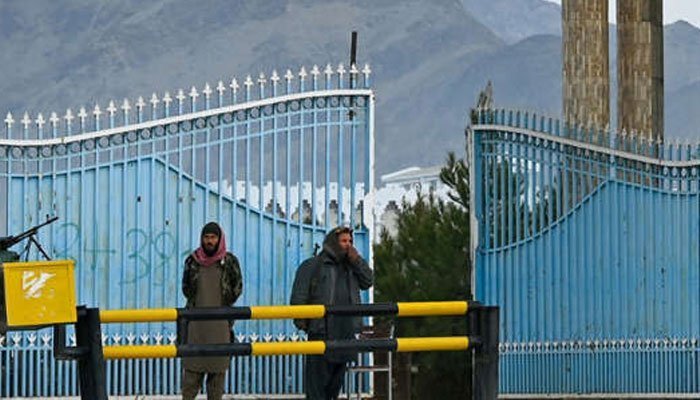
Turnout was very low and Taliban fighters guarded the entrance, a tripod-mounted machine gun perched on a barrier.
Most students declined to comment on returning to class, and some said they had been warned by authorities not to speak to the press.
Journalists were not allowed to enter the Laghman campus and universities in other provinces.
Critical Marking
The Taliban have said they have no objection to women’s education, but want class segregation and curriculum based on Islamic principles.
“We were told that the classes are taught according to Sharia law,” said Malik Samadi, a 23-year-old math student.
“I hope they hold all the courses because society needs them.”
“Education is the foundation of a country,” says civil engineering student Munsefullah at Helmand University, who is happy that he has returned to college.
But while she was happy to return to college, one student looked pessimistic beyond her studies.
“We are also saddened that as political and law students we are endangering our future because we cannot get jobs under this regime,” said Khadija Azizi of Nangarhar University.
“It is not more pleasant for us because we have lost hope for our future.”
On Tuesday, the United Nations relief mission in Afghanistan said reopening universities was an “important step” because it provided equal access to education for all.
The reopening comes a week after a Taliban delegation held talks with Western officials in Norway, where they were pressured to improve women’s rights to unlock billions of dollars in seized assets and frozen foreign aid.
The cessation of aid has sparked a humanitarian crisis in Afghanistan, already devastated by decades of war.
No country has yet recognized the new Taliban regime, which has promised a softer version of the harsh rule that characterized their first stint in power.
The regime has imposed various restrictions on women, including banning many government jobs.
The Taliban say all girls’ schools will reopen by the end of March.
“The reopening of public universities…would bode well for girls’ return (to school) across the country,” said Andrew Watkins, an analyst with the American Institute of Peace. AFP.
“This is the Taliban taking a step that would be a crucial milestone in moving closer to recognition.”