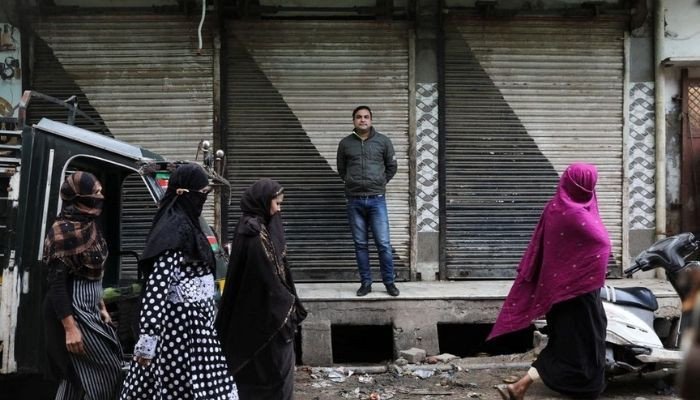


MATHURA: In the streets surrounding a revered religious site in the Indian city of Mathura, where a temple and a mosque sit side by side, the handful of Muslim restaurants that remain are largely empty or closed.
A meat ban last year by the chief minister of Uttar Pradesh state, a Hindu monk who issued the order on religious grounds, has decimated their trade.
Now saffron-clad Yogi Adityanath, who will be reelected in the state’s key polls next month, has turned his attention to the temple itself, suggesting he will defend the Hindu cause in a long-running dispute with Muslims over who will own it. is from the site.
The issue has become a central part of the ruling party’s campaign to extend its grip on power in Uttar Pradesh, home to 200 million people and the hub of national politics.
Hindus and Muslims have argued for decades over who should control the site, echoing other disputes in India that sometimes resulted in deadly riots between the two communities.
While inter-communal violence in India is sporadic, clashes erupted across the country in early 2020 over a citizenship law that Muslims believed discriminated against. Dozens of people died.
According to interviews with more than 20 residents, the mention of the Mathura dispute at campaign rallies and on social media worries the city’s Muslims.
“An old case that has been resolved… is being revived because we have a new, triumphant Hinduism,” said Nilanjan Mukhopadhyay, author of several books on Prime Minister Narendra Modi and the Hindu nationalist movement.
“There is a greater emphasis on playing the temple card.”
Opinion polls suggest the Hindu nationalist Bharatiya Janata Party (BJP), to which Adityanath belongs, will win the vote in Uttar Pradesh, despite widespread discontent with the economy and the government’s handling of the pandemic.
The prime minister, seen by some analysts as a potential successor to Modi, has cast the vote as “80% versus 20%”, numbers he has not fully explained. The percentages closely match the Hindu and Muslim proportions of the population in the state.
Adityanath’s office did not respond to a request for comment on the situation in Mathura.
‘NOTHING TO FEAR’
The BJP came to power in Uttar Pradesh in 2017 on a Hindu first agenda, not proposing a single Muslim candidate. Indians vote for powerful state legislators separately from national parliamentary elections.
That victory reflected the party’s national dominance since Modi came to power in 2014 after appealing to the Hindu majority.
The main opposition party in Congress complains that by putting Hindus first, he and the BJP discriminate against minorities and risk fomenting violence. Modi has defended his record, saying his economic and social policies benefit all Indians.
Jamal Siddiqui, head of the BJP’s minority committee, said the party is working to increase the number of minority candidates in Uttar Pradesh and the four other states who will go to the polls next month.
“I hope the minority community will participate in both the elections and the government,” he told Reuters. “Modi’s government has protected religious sites for all religions. Now, instead of fearing saffron, Muslims are moving closer.”
Suspicion of the BJP among Muslims in Mathura was sparked by misleading claims by opposition parties, Siddiqui added.
‘NO COMPROMISE’
One of the holiest cities in Hinduism, Mathura, located about 150 km south of New Delhi, is considered the birthplace of Krishna, one of the most important Hindu gods.
A temple that stood on the famous site of his birth was razed to the ground in the 17th century during the Muslim Mughal Empire and replaced by a mosque known as the Shahi Eidgah. A Hindu temple complex built in the 1950s now adjoins the mosque.
An agreement was made in 1968 to regulate the use of the land, and the two structures stood as “two sisters” until legal action to demolish the mosque began in 2020, said Z. Hassan, chairman of the trust that administers the Eidgah .
“I’ve been here for 55 years. I haven’t felt any tension between Hindus and Muslims,” he said. “It’s only in recent years that the idea that there are two communities has emerged.”
The case, brought before a local court by several Hindu priests, says the 1968 agreement was fraudulent.
“This country is very important to us,” said Vishnu Jain, the lawyer representing the petitioners. “I don’t believe in any kind of dialogue. There is only one compromise that can be reached: that they will be out of this property.”
Both sides expect the case to last for years.
The local dispute has been picked up by Adityanath and several other BJP leaders during campaigns.
He told a meeting last month that construction of a temple in Mathura, along the lines of a similar development in Ayodhya, is “ongoing”, without giving more details.
Ayodhya was the scene of communal violence in 1992 and 1993, in which more than 2,000 people died, after a mob demolished the 16th-century Babri Masjid mosque, which many Hindus believe was the birthplace of Lord Rama – another important deity.
A court ruling allowing the construction of a temple on the site of Babri Masjid was a key campaign issue in the 2019 general election, when the BJP increased its majority.
‘THE LAND IS OURS’
Many Hindu residents of Mathura support plans to reclaim the land of the mosque.
“The land is ours and must be returned,” said Bipin Goswami, a 19-year-old with his face smeared with saffron and sandalwood paste.
Local authorities mobilized thousands of security personnel in December after fringe Hindu groups announced an attempt to place a statue of Krishna in the mosque on the anniversary of the destruction of the Babri Masjid.
The attempt failed, but at the mosque, which has been lined with barbed wire and watchtowers since the early 1990s, police are now checking the ID cards of anyone entering the complex.
Aved Khan, a 30-year-old Muslim who owns a food cart in Mathura, said he changed his company’s name from Srinath Dosa to American Dosa Corner after a group of men demanded that he stop using a Hindu name.
“You are Muslim, how can you have this name?” one of the men asked, removing the signs from the stall, according to a police report of the August incident.
Rajesh Mani Tripathi, the national president of the Shri Krishna Janmabhoomi Mukti Dal – a hardline Hindu group that was also behind the attempt to install the statue – told Reuters he was one of the men involved in the altercation.
“If he was a Muslim, he should write his name on the banner and not cheat people by mentioning a Hindu name,” he said.
Muslims in Mathura also complained about Adityanath’s decision in September to ban meat within a 3 km radius of the temple.
The empty Royal Restaurant, one of the few in the area still open, cooks traditional lamb kebabs and soy chicken tikkas.
“For the BJP, there was no tension here,” said Sajid Anwar, standing in front of his closed Labbaik Restaurant.
Anwar said there is no demand for vegetarian food among Muslims. He awaits the election results before deciding whether to close for good.
“When Yogi comes back, I’ll have to find another subject.”