
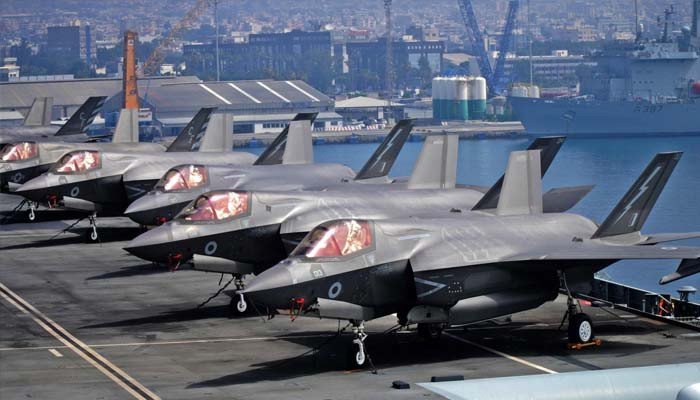


- The commitment, to “assist the UAE against the current threat”, follows a telephone conversation between the US Secretary of Defense and the Crown Prince of Abu Dhabi.
- The US approved air-to-air missiles to Saudi Arabia in November to help the country protect itself from Houthi drone attacks.
- A $23 billion US weapons package to the UAE, including F-35 fighter jets, has yet to be finalized.
Dubai: The United States will send a warship and fighter jets to help defend the United Arab Emirates, officials said Wednesday after rocket attacks by Yemeni rebels that killed three in the wealthy Gulf state.
The commitment to “assist the UAE against the current threat” follows a telephone conversation between Defense Secretary Lloyd Austin and Abu Dhabi Crown Prince Mohammed bin Zayed Al-Nahyan, the US embassy in the UAE said.
The UAE, a major financial center and part of the Saudi Arabia-led coalition that has been fighting Yemen-backed Houthi rebels for seven years, suffered a third consecutive rocket attack on Monday.
As part of the new arrangements, the guided-missile destroyer USS Cole will partner with the UAE Navy and make a port call in Abu Dhabi, while the US will also deploy “fifth generation” combat aircraft, which are the most advanced.
Other actions include “continuing to provide early warning information (and) working together on air defense,” the embassy said.
The USS Cole, currently docked in Bahrain’s port, was bombed by al-Qaeda in the Yemeni port city of Aden in October 2000, killing 17 sailors.
Austin and the Crown Prince “discussed the recent Huthi attacks on the UAE that caused civilian casualties and also threatened US and Emirati forces stationed at Al Dhafra Air Force Base,” the embassy added.
In the rebel-held Yemeni capital of Sanaa, senior Huthi official Sultan al-Samei rejected US support.
“These new troops that have arrived or will arrive in the UAE do not deter us,” he said.
“We will not stop what we have started, defend ourselves and we will not stop until the aggression against our country stops, nor when the UAE-backed troops withdraw.”
The rebel attacks on the UAE have added a new dimension to Yemen’s Seven Years’ War, which killed an estimated 377,000 people directly or indirectly and displaced millions.
Three foreign workers were killed in a drone and missile attack on Abu Dhabi’s oil facilities and airport on January 17, triggering a salvo of deadly airstrikes in retaliation.
On January 24, US troops stationed at Abu Dhabi’s Al Dhafra Air Force Base fired Patriot interceptors and rushed into bunkers when two ballistic missiles were shot down over the city.
And on Monday, a third rocket attack was thwarted during a visit to the UAE by Israeli President Isaac Herzog.
The US, a staunch ally of Saudi Arabia and the UAE, plans the deployment to “send a clear signal that the United States stands behind the UAE as a long-term strategic partner,” the embassy said.
President Joe Biden withdrew US support for the Saudi Arabia-led intervention in Yemen after taking office early last year, reversing his predecessor’s policy of providing logistical aid.
However, the US State Department announced in November the approval of the sale of $650 million worth of air-to-air missiles to Saudi Arabia to help the country protect itself from Huthi drone attacks.
A $23 billion US weapons package to the UAE, including F-35 fighter jets, is yet to be finalized, with the Emirates threatening to scrap the deal over strict terms.
The rebel attacks have heightened tensions in the Gulf at a time when international talks over Iran’s nuclear program are faltering, and have helped push oil prices to their highest levels in seven years.
They started after a series of ground defeats in Yemen inflicted by the UAE-trained Giants Brigades militia.
In early January, the rebels seized a UAE-flagged ship in the Red Sea and said it was carrying weapons – a claim denied by the Emirates.
Yemen’s civil war started in 2014 when the Huthis took Sanaa, prompting Saudi Arabia-led forces to intervene the following year to support the government.
The UAE, one of the world’s largest arms buyers, announced a reshuffle of Yemen in 2019, but remains an influential player.
The UN calls Yemen the world’s worst humanitarian crisis, with millions on the brink of starvation.